
A2P Is Getting Stricter, are you Prepared?
Brand ID requirements are here. Learn how to avoid violations and suspensions below 👇
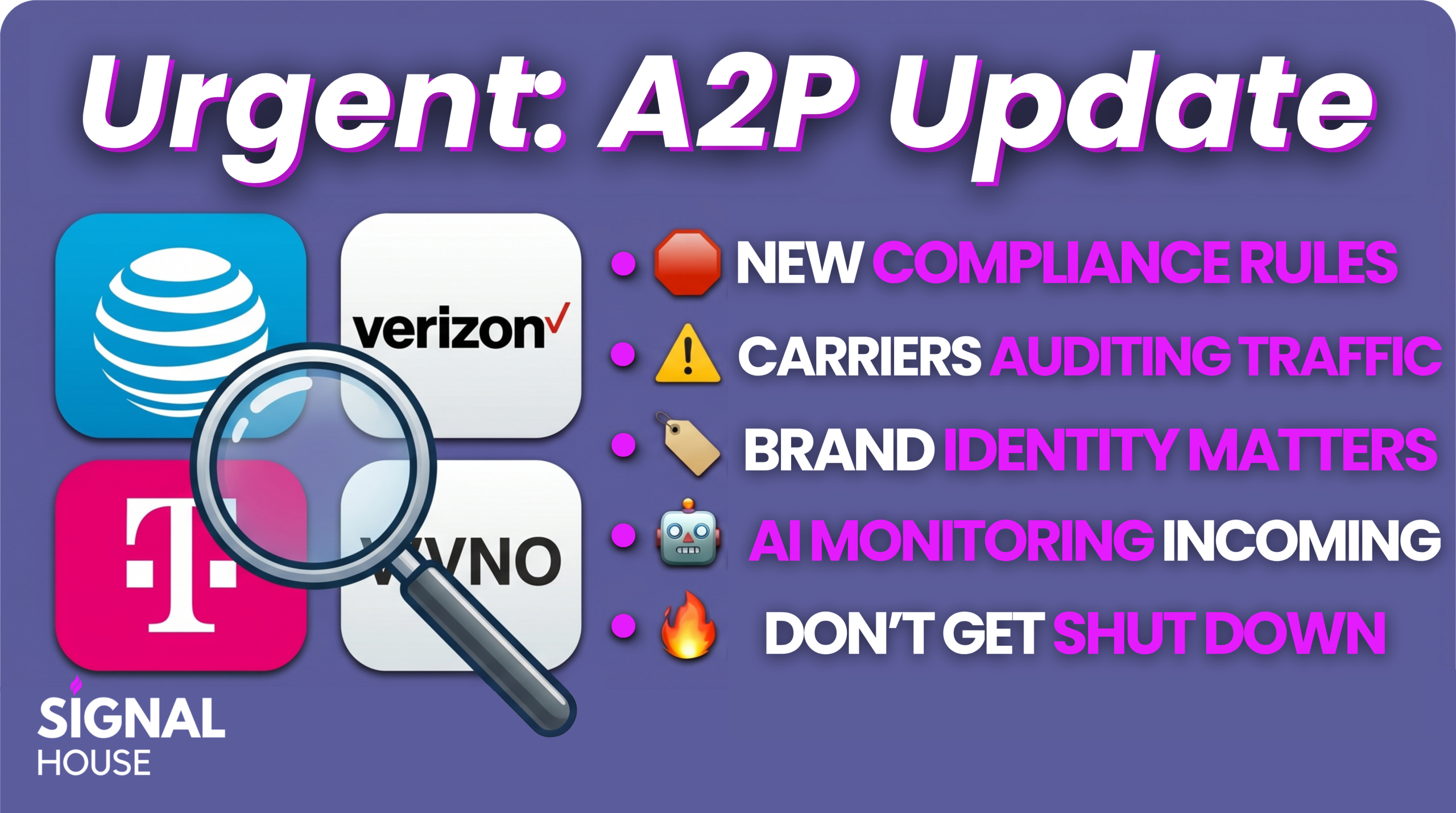
Why Compliance is Key for A2P SMS: The New Brand Identity Rules You Can’t Ignore 🛑
Have you noticed the shifting sands in the business messaging space lately? ⏳
If you are sending application-to-person (A2P) traffic across the major networks via short codes, toll-free, or 10DLC numbers, things are changing fast 💨. We recently caught up with our primary carrier partners and a major Mobile Virtual Network Operator (MVNO) that terminates traffic across T-Mobile and Verizon. They all gave us the exact same warning: Carriers are actively auditing traffic like never before🕵️♀️
The compliance playbook is getting a massive rewrite 📝. Rules that were once loosely enforced “guidelines” are now being turned into hard filters 🛑
If you aren’t adapting, your text message campaigns risk being irrevocably shut down 😬. Here is exactly what the carriers are looking for right now, the two compliance funnels you need to avoid, and what’s coming in the future 👇
Want to see the video that inspired this post? You can do so Here!
What Are Carriers Looking For? Brand Identity! 🏷️
For years, the CTIA guidelines have stated that businesses must identify themselves. However, it wasn’t strictly imposed in the same way that opt-out keywords (like “STOP”) were.
That era is over. Brand Identity is now a top priority.
The Rule: You must clearly announce your business name in your initial outreach message.
-
Does it have to be my legal company name? Not necessarily. Your legal name and public brand name are allowed to be different—but they must be directly representative of one another.
-
The Pepsi Principle: Think of PepsiCo. If the legal entity name is PepsiCo, but they are sending an SMS marketing campaign for Mountain Dew, the brand name used in the text should be “Mountain Dew.” There just needs to be a verifiable business relationship between that brand and the legal registration ✅
The end subscriber must be able to clearly see who is texting them from the very first interaction. 📲
The Two Compliance Funnels: How Campaigns Get Caught 🌪️
Carriers are policing this rule in two distinct ways—one that is happening in the here and now, and one that is being engineered for the future.
1️⃣ Funnel #1: The “Here and Now” (Manual Audits & Sentiment Triggers)
Right now, audits happen when eyes get on your campaign. How do eyes get on your campaign? Usually, it’s driven by two triggers:
-
Non-Consensual Complaints: A user reaches out directly to their carrier (like AT&T or Verizon) to complain that you texted them without consent.
-
Negative Sentiment: If your campaign’s negative sentiment climbs above 5%, it triggers an automatic red flag. Negative sentiment doesn’t just mean opt-out keywords. It includes angry replies, expletives, or messages like “Don’t ever text me again, I hate you.” 🤬
Once a campaign is flagged, the carrier hands it to the Direct Connect Aggregator (DCA), and a manual review begins.
The first thing they look for is Brand ID. If your brand name is clearly visible in the message and matches your campaign registration, it drops down to a standard Consent Audit. The aggregator will ask you for proof of opt-in consent. You provide it, everything looks good, and you’re off to the races! 🙌
But what happens if the brand name is missing or wrong? You get hit with a Sev-Zero Violation. This is the highest severity violation possible. The carriers won’t just fine you; they will irrevocably shut down your campaign for circumventing registration requirements. ❌
2️⃣ Funnel #2: The Future (AI-Powered Filtering) 🤖
Carriers are actively training and preparing AI models to scan outbound text traffic automatically.
In the near future, enforcement won’t rely on a user complaining first. LLMs and automated filters will scan traffic flows in real-time 🤖. If the model detects a business message flow that fails to mention the registered business name in the copy, the message will get flagged and filtered automatically before it ever reaches the handset 🫥
The “Bad Actor” Signals: Are Your Lists Mimicking Spam? 🙅
Appearing to be a bad actor is just as dangerous as actually being one. Carriers look at inbound-to-outbound ratios and response patterns to gauge the health of your traffic.
If a large percentage of your incoming replies look like this:
-
“Hey, this isn’t [Name]’s phone.”
-
“This business closed down 10 years ago.”
-
“I haven’t worked there in years, stop texting me.”
The carrier’s system immediately assumes you are operating off of stale, cold data or an unverified, purchased lead list. This pattern immediately draws compliance scrutiny to your campaigns 🚩
How to Protect Your SMS Deliverability 💡
Staying compliant doesn’t have to be complicated. To keep your traffic running smoothly, implement these three core practices:
-
Lead with Your Brand: Bake your registered brand name naturally into the first line of every initial outreach template 📝
-
Ditch the Bought Lists: Never use cold lead aggregation lists. Stick exclusively to clean, first-party data where explicit SMS opt-in consent was captured 🧼
-
Keep Lists Current: Regularly clean and update your database to weed out old, dead numbers or recycled contacts before they hurt your sending reputation 📈
Navigate A2P Compliance Effortlessly with Signal House 🤝
The shifting sands of compliance can feel overwhelming, but they don’t have to slow down your business. At Signal House, we specialize in helping businesses navigate A2P 10DLC, Toll-Free, and Short Code messaging with full transparency, deep analytics, and smooth compliance at scale.
Want to ensure your campaigns are built to survive the new carrier standards? Connect with our team today and let’s optimize your messaging! 😎🙌